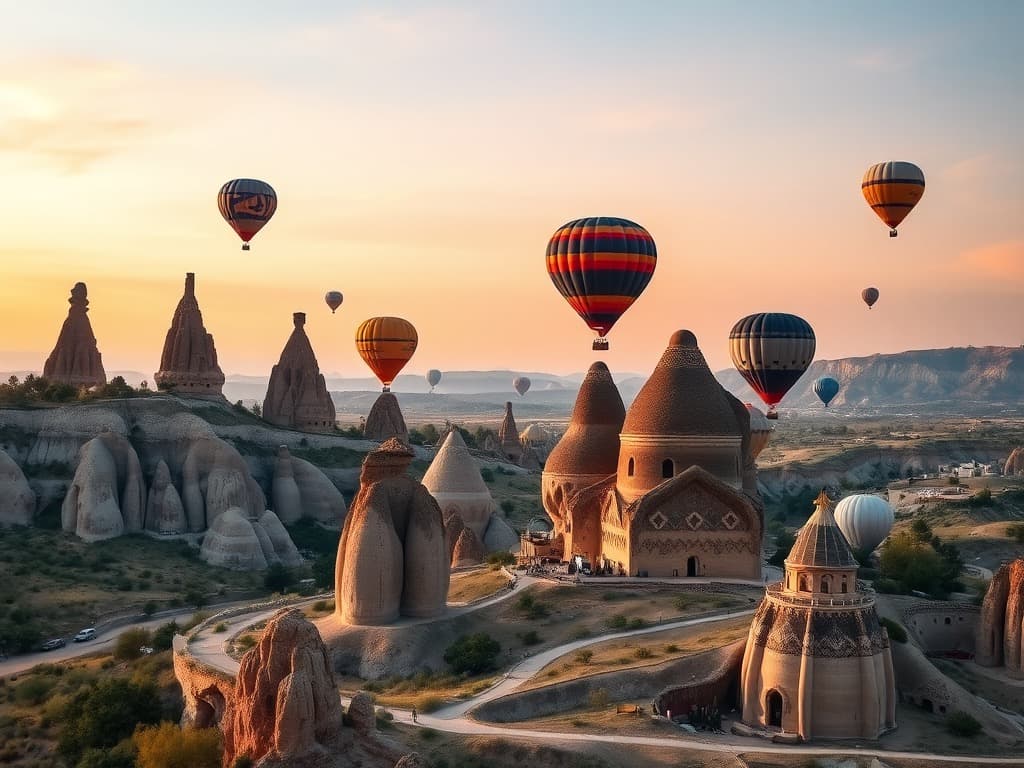
Cappadocia's main attractions fall into five clusters: the rock-cut churches and valleys of Uçhisar and Göreme, the fairy chimneys of Çavuşin, Paşabağ, Zelve and Devrent, the potters' town of Avanos, the towns of Ürgüp, Ortahisar and Mustafapaşa, and the underground cities of Kaymaklı and Derinkuyu. Ihlara Valley and Selime need a separate day. Apart from Ihlara, everything lies within about 40 km of Uçhisar, so half-day loops grouped by direction work best.
The places to visit in Cappadocia fall into five clusters, all between 1 and 40 km (about 25 miles) from Uçhisar: the rock-cut churches and valleys of Uçhisar and Göreme; the fairy chimneys of Çavuşin, Paşabağ, Zelve and Devrent; the potters' town of Avanos; Ürgüp, Ortahisar and Mustafapaşa; and the underground cities of Kaymaklı and Derinkuyu. Ihlara Valley and Selime need a day of their own.
Much of this landscape lies inside "Göreme National Park and the Rock Sites of Cappadocia", inscribed on the UNESCO World Heritage List in 1985. The listed area covers the land between Nevşehir, Ürgüp and Avanos plus the Kaymaklı and Derinkuyu underground cities. Fairy chimneys (peribacası in Turkish) are cones of soft volcanic tuff left standing by erosion, often topped by a cap of harder rock. Distances below are approximate road distances from Uçhisar, the village where our hotel, Zeppelin Cappadocia, stands. If you have not settled on the length of your trip yet, read how many days to spend in Cappadocia alongside this guide.
Cappadocia attractions at a glance: distance, time and timing
Times assume an unhurried visit without a guide; organised tours usually spend less time at each stop.
| Place | Area | From Uçhisar | Time to allow | Best time |
|---|---|---|---|---|
| Uçhisar Castle | Uçhisar | ~1 km (~15 min walk) | 45–60 min | Late afternoon, towards sunset |
| Pigeon Valley | Uçhisar–Göreme | ~1.1 km (trailhead) | 1.5–2 h (to Göreme) | Morning or late afternoon |
| Göreme Open-Air Museum | Göreme | ~6.5 km (~15 min drive) | 1.5–2 h | Opening time or the last 90 minutes |
| Çavuşin old village | Çavuşin | ~8.5 km | 30–45 min | Morning |
| Paşabağ (Monks Valley) | Between Çavuşin and Zelve | ~11 km | 30–45 min | Morning or late afternoon |
| Zelve Open-Air Museum | Avanos (Aktepe) | ~12.5 km | 1–1.5 h | Cool of the morning |
| Devrent (Imagination) Valley | Avanos–Ürgüp road | ~19 km | 15–20 min | Any time |
| Avanos | Avanos | ~14 km (~20 min) | 1.5–2 h | Afternoon |
| Ortahisar | Ortahisar | ~10 km | 45–60 min | Afternoon |
| Ürgüp and the Three Beauties | Ürgüp | ~14 km (~20 min) | 1–2 h | Late afternoon |
| Mustafapaşa | South of Ürgüp | ~20 km | 1–2 h | Midday |
| Kaymaklı Underground City | Kaymaklı | ~28 km (~30 min) | 45–60 min | Midday; very hot or cold days |
| Derinkuyu Underground City | Derinkuyu | ~38 km (~40 min) | 45–60 min | Midday |
| Ihlara Valley and Selime | Aksaray province | ~80 km (~1 h 20 min) | Full day | Leave early |
Uçhisar: the castle, Pigeon Valley and viewpoints
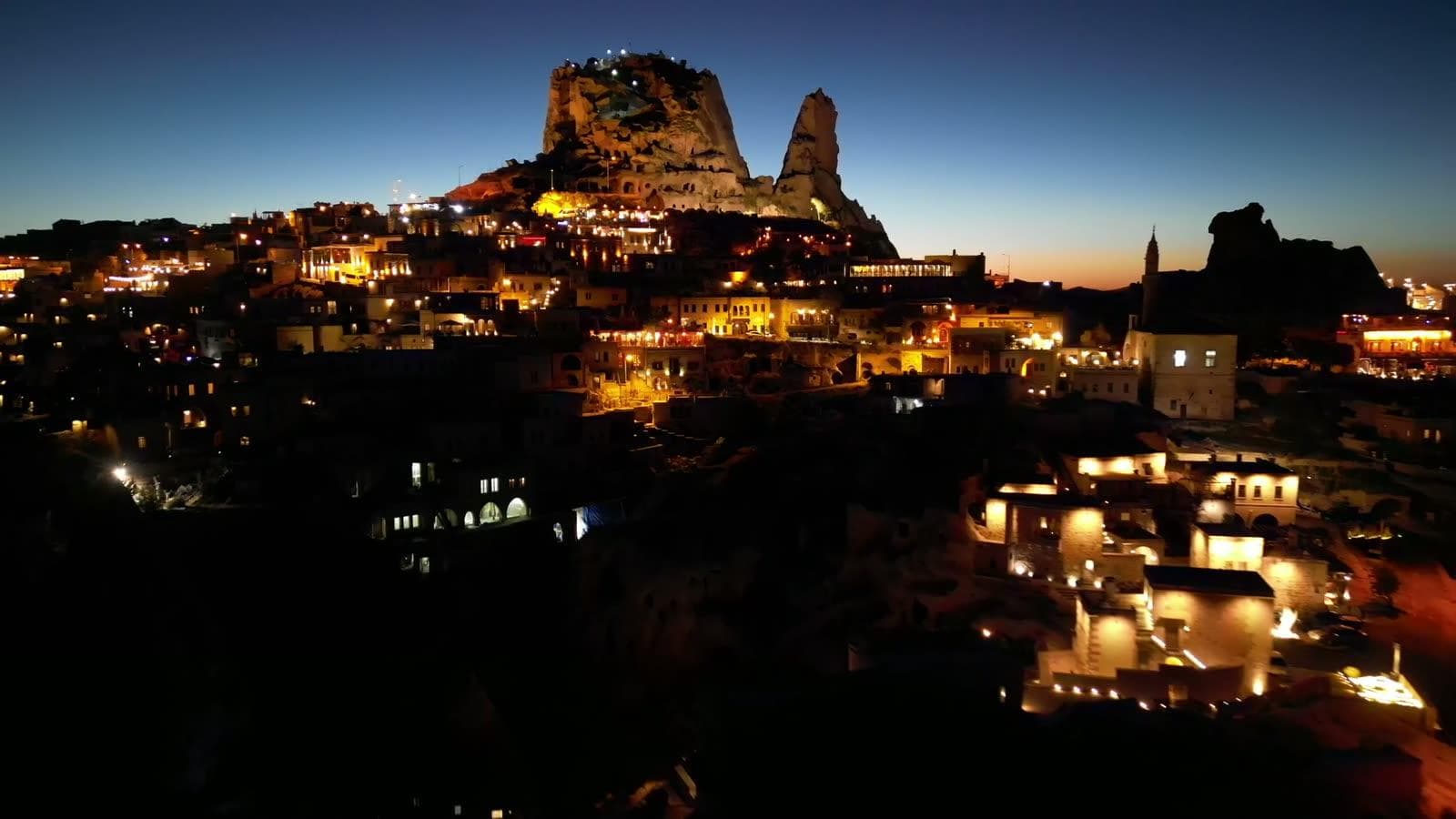
Uçhisar is the village on the high ground above the Göreme valleys. Its landmark, Uçhisar Castle, is not a built fortress but a huge tuff outcrop honeycombed with rooms, storerooms and tunnels, used as a refuge by local people from Roman times to the early years of the Turkish Republic. The municipality runs it today, and from the top you look over Pigeon Valley, Göreme's chimneys and, on clear days, the volcanic cone of Mount Erciyes. Hours and the climb are covered in our Uçhisar Castle guide.
Pigeon Valley (Güvercinlik Vadisi) runs for about 4 km from the foot of the castle down to Göreme. The dovecotes carved into its walls were made to collect pigeon droppings, which farmers used to fertilise their vineyards. Because Uçhisar sits higher than Göreme, starting here means walking mostly downhill; the full trail takes 1.5–2 hours. The tree hung with blue evil-eye beads (nazar boncuğu) at the Uçhisar trailhead is the valley's most photographed spot. More routes are in our Cappadocia valley hikes guide.
Göreme: the Open-Air Museum, rock churches and valleys
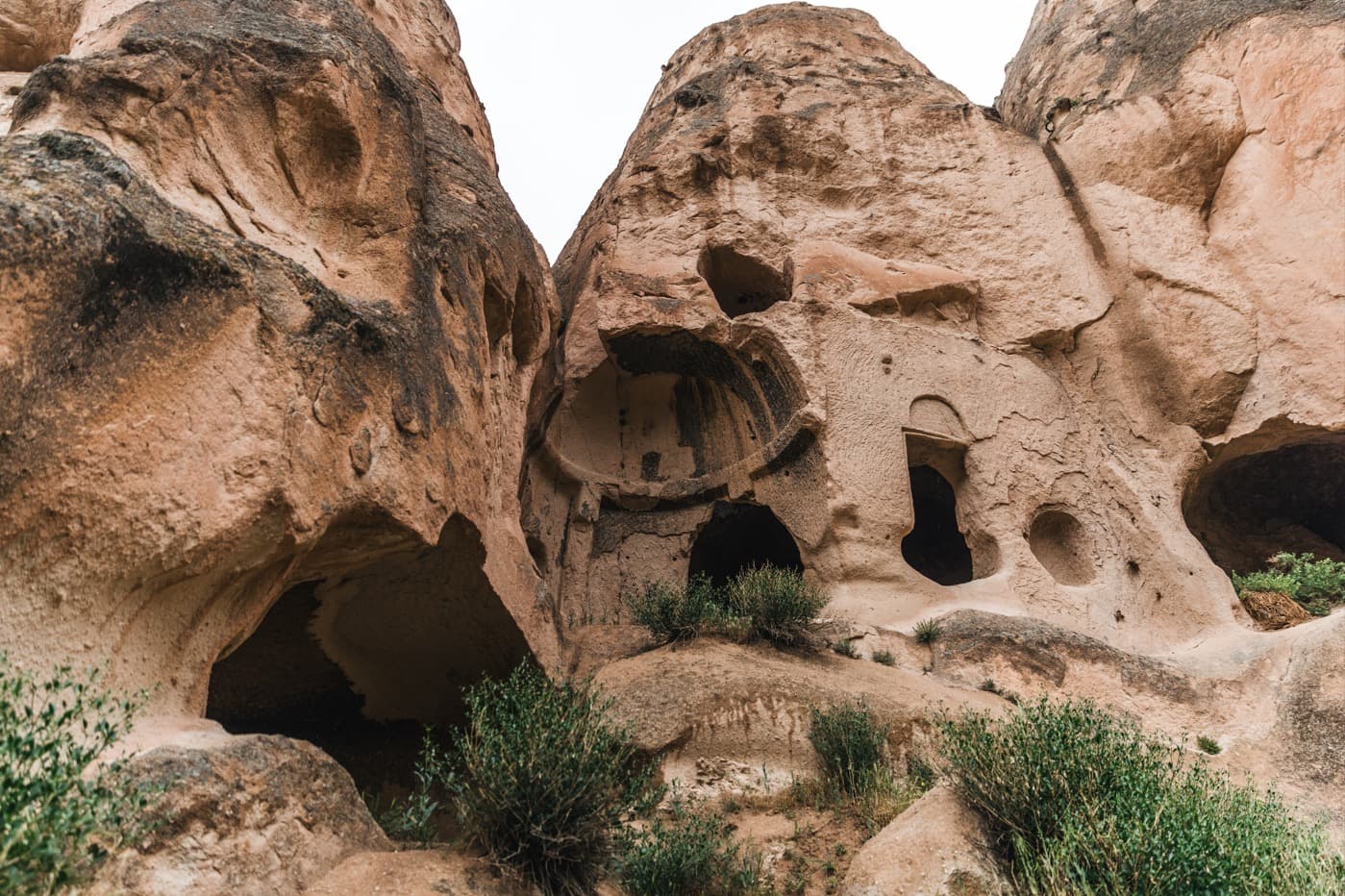
The Göreme Open-Air Museum, listed by the Ministry as Göreme Örenyeri ("archaeological site"), lies about 2 km east of Göreme village. Between the 4th and 13th centuries it was a busy monastic settlement of rock-cut churches, chapels and refectories. UNESCO counts Cappadocia's painted churches among the leading examples of Byzantine art after the Iconoclastic period (725–842), when church decoration was limited to simple symbols such as crosses. Elmalı, Yılanlı and Çarıklı churches are inside the main enclosure; the Dark Church (Karanlık Kilise), with some of the best-preserved frescoes in the region, needs its own ticket, and Tokalı Church sits just outside the gate on the main ticket. For timings, tickets and a route, see our Göreme Open-Air Museum guide.
El Nazar Church, in the Zemi Valley east of Göreme, is a small church that UNESCO dates to the 10th century, painted mostly with the great feasts of the Christian calendar. Around the village, the Kılıçlar (Swords), Love (Bağlıdere) and Rose–Red (Güllüdere–Kızılçukur) valleys are the classic walks and sunset spots. For the hills where you can watch the balloons take off, see Cappadocia sunrise and balloon viewpoints.
Çavuşin, Paşabağ, Zelve and Devrent: fairy chimney country
In Çavuşin, the old village climbs a cliff face of cave houses. Guidebooks say it was abandoned decades ago because of rock falls; a path of about 15 minutes leads up through it to the Church of St John the Baptist, counted among the oldest rock churches in the region. Down on the Göreme–Avanos road, Çavuşin Church was carved in 964–965 after Byzantine Emperor Nikephoros Phokas visited Cappadocia; the Ministry's page lists it as closed for restoration as of November 2026.
Paşabağ, which the Ministry notes was once called the Valley of the Priests (usually translated as Monks Valley), is known for chimneys that split into two or three caps. One three-headed chimney holds a chapel and hermit's cell dedicated to St Simeon, the 5th-century ascetic who lived on top of a column near Aleppo. Paşabağ and Zelve are run as a single site (Zelve–Paşabağları). Zelve spreads over three valleys and was inhabited until 1952; churches, a mosque, a mill once used for bulgur and dovecotes with decorated facades remain.
Devrent Valley, also called Imagination Valley, has no churches: it is a roadside stop on the Avanos–Ürgüp road where tuff formations resemble animals, the best known being a camel. Most of this stretch is covered by the so-called Red Tour; we compare it with the Green and Blue tours in Cappadocia's red, green and blue tours.
Avanos: the Red River and its potters
Avanos lies on the Kızılırmak ("Red River"), Türkiye's longest river and the Halys of antiquity. The Ministry of Culture and Tourism traces the town's ceramic trade back to the Hittites, and workshops in the old town still use the traditional kick wheel; many let visitors try throwing a pot.
About 6 km from town stands Sarıhan, a 13th-century Seljuk caravanserai with an elaborately carved stone gateway. For dinner ideas, our guide to pottery kebab and where to eat it covers the region's signature dish, cooked in a sealed clay pot.
Ürgüp, Ortahisar and Mustafapaşa: towns, a second castle and old mansions
Ortahisar has its own rock citadel rising from the village centre. Access to the top has at times been restricted for restoration and safety work, so ask locally before you go. The village is also known for rock-cut cold stores where citrus fruit and potatoes are still kept.
Ürgüp is a busy small town known for the view from Temenni Hill in its centre and for the Three Beauties (Üç Güzeller), three capped fairy chimneys that draw crowds at sunrise and sunset. South of Ürgüp, Mustafapaşa (formerly Sinasos) has stone mansions built mostly in the 18th and 19th centuries by a prosperous Greek Orthodox merchant community. The inscription on the Church of Saints Constantine and Helena on the square records construction in 1729 and repairs in 1850. The village's Greek residents left in the 1924 population exchange and families from Thessaloniki settled in their place; the Mehmet Şakir Pasha Madrasa of 1899 is now used by Cappadocia University.
The underground cities: Kaymaklı and Derinkuyu
The Ministry estimates that Cappadocia has 150–200 underground settlements of varying sizes. They were dug downwards into soft tuff as refuges in times of danger, with low, narrow galleries designed to slow intruders down. Inside, the air stays cool in summer and milder than outside in winter.
- Kaymaklı (about 28 km from Uçhisar): four levels have been excavated so far, linked by low, sloping passages. On the third level, an andesite block with 57 carved hollows was used for crushing and grinding.
- Derinkuyu (about 38 km): reaches roughly 85 m below ground, opened to visitors in 1965, and only about 10 percent of it can be visited today. A 55 m ventilation shaft doubled as a well.
If you are claustrophobic or have bad knees, think twice: some passages require crouching. The history of the underground cities, plus lesser-known examples such as Özkonak and Tatlarin, is covered in our guide to Cappadocia's ancient sites and underground cities.
Day trip: Ihlara Valley and Selime Monastery
Ihlara Valley, in the Güzelyurt district of Aksaray province, is a canyon about 14 km long and up to 120 m deep according to the Ministry, cut by the Melendiz stream. Its walls hide frescoed churches: the best known are Ağaçaltı Church, with paintings dated to the 9th–11th centuries, and Kırkdamaltı (St George) Church at Belisırma, decorated between 1283 and 1295. There are entrances at Ihlara (the main gate), Belisırma and Selime.
At the Selime end rises Selime Monastery, carved over several levels and regarded as one of the largest rock-cut religious complexes in Cappadocia. The drive from Uçhisar to Ihlara is about 80 km (around 1 h 20 min each way), so allow a full day. The organised Green Tour usually pairs the valley with Derinkuyu or Kaymaklı.
Half-day loops from Uçhisar, plus the Museum Pass
Grouping sights by direction saves you from driving the same roads twice. Five easy half-days from Uçhisar:
- Uçhisar on foot: walk Pigeon Valley down to Göreme in the morning, come back by taxi and climb the castle towards sunset. No car needed.
- Göreme morning: the Open-Air Museum and Tokalı Church at opening time, then El Nazar Church and lunch in Göreme.
- Northern loop: Çavuşin → Paşabağ → Zelve → Devrent → Avanos, ending at a pottery workshop by the river.
- Southern loop: Ortahisar → Ürgüp (Temenni Hill, Three Beauties) → Mustafapaşa.
- Underground half-day: Kaymaklı and Derinkuyu, about 10 km apart on the same road.
To drive the loops at your own pace, see our Cappadocia car rental guide; if this is your first trip, our first-timer's guide to Cappadocia helps you set priorities.
Museum Pass Cappadocia and the MüzeKart
According to the Ministry's official ticket site, muze.gov.tr, the Museum Pass Cappadocia is valid for 3 days from your first museum entry and allows one entry per site; it costs €65 (as of 2026; subject to change). It covers more than 10 sites, including the Göreme Open-Air Museum, the Dark Church, Zelve–Paşabağ, Kaymaklı, Derinkuyu, Özkonak and Ihlara Valley (with the Selime and Belisırma entrances), but not night-time openings. Turkish citizens use the MüzeKart instead. Uçhisar Castle is run by the municipality, so neither card applies there.
Every loop above starts within a 40-minute drive of Uçhisar, and the first one starts at the door. Zeppelin Cappadocia has free on-site parking and a tour desk that can book tours, balloon flights and transfers, so an early start at the museum and an evening back on a terrace facing Uçhisar Castle are easy to combine. See why the village works as a base on our Uçhisar hotel page, compare areas in where to stay in Cappadocia, or browse our 12 stone rooms.
Sources
- UNESCO World Heritage Centre – Göreme National Park and the Rock Sites of Cappadocia
- T.C. Kültür ve Turizm Bakanlığı (muze.gov.tr) – MuseumPass Cappadocia
- T.C. Kültür ve Turizm Bakanlığı (muze.gov.tr) – Derinkuyu Yeraltı Şehri
- T.C. Kültür ve Turizm Bakanlığı (muze.gov.tr) – Ihlara Vadisi
- Türkiye Müzeleri – Nevşehir Zelve-Paşabağları Örenyeri