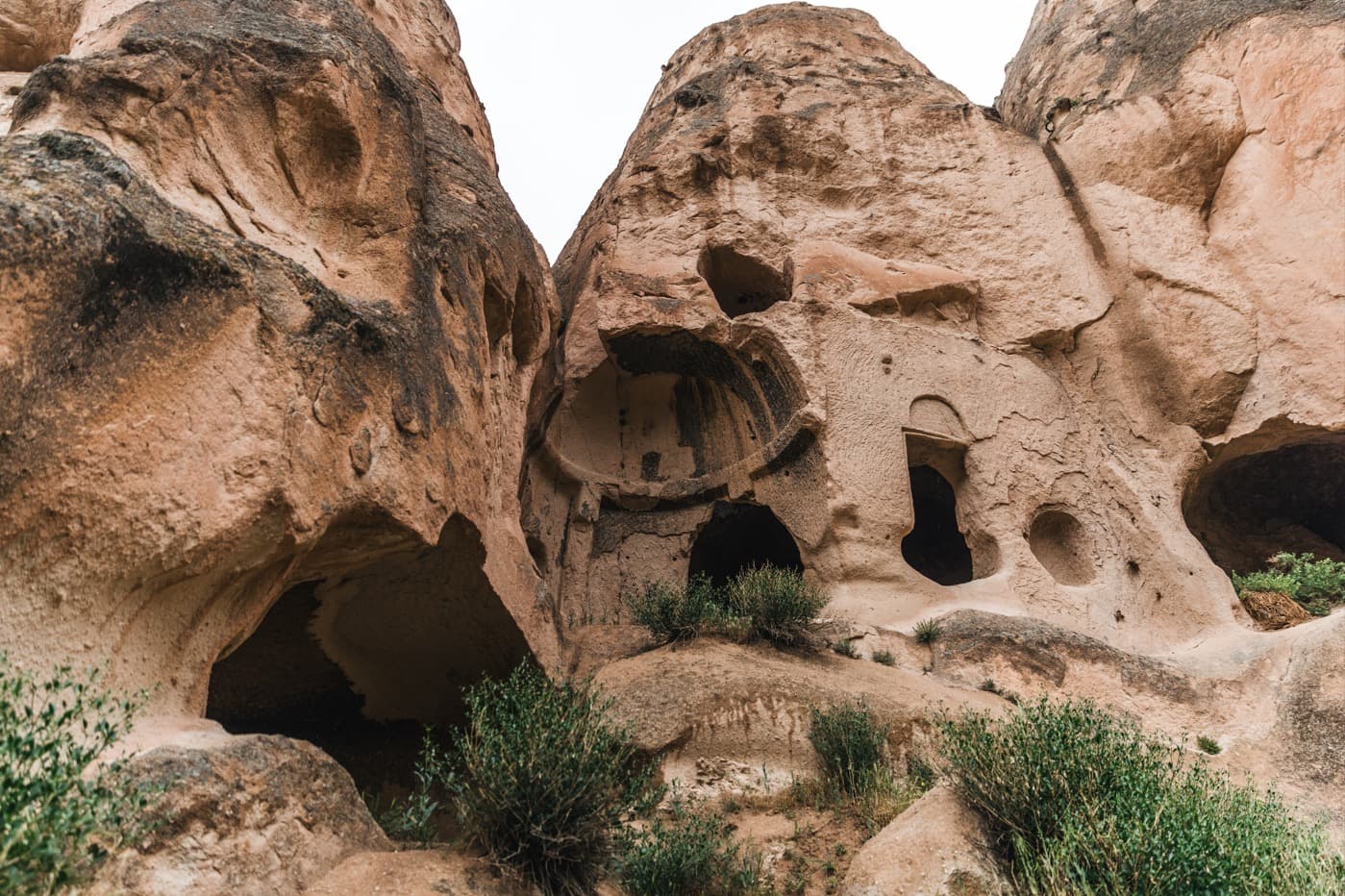
The Göreme Open-Air Museum is a UNESCO-listed complex of rock-cut churches and chapels about 2 km east of Göreme village, home to a monastic community from the 4th to the 13th century. Allow 1.5–2 hours for the main area; the Dark Church needs a separate ticket, while Tokalı Church, just outside the gate, is on the main ticket. Buy tickets at the gate or on the official muze.gov.tr site and arrive at opening time to avoid tour groups.
The Göreme Open-Air Museum is a cluster of rock-cut churches, chapels and refectories about 2 km (1.2 miles) east of Göreme village, home to a monastic community from the 4th to the 13th century. Allow 1.5–2 hours for the main area. The Dark Church needs a separate ticket; Tokalı Church stands outside the gate and is on the main ticket. Arrive at opening time to beat the tour groups.
Listed by the Ministry of Culture and Tourism as "Göreme Örenyeri" (Göreme archaeological site), it opened to visitors in 1967. From Uçhisar, where our hotel Zeppelin Cappadocia stands, it is about 6.5 km or a 15-minute drive. This guide covers the main churches, the official ticket and opening-hour information, and a practical plan for your visit.
What is the Göreme Open-Air Museum? Monks, frescoes and UNESCO
Monastic life in Cappadocia goes back to the 4th century. According to UNESCO, small communities of hermits following the teachings of Basil the Great, Bishop of Kayseri (ancient Caesarea), began living in cells cut into the rock. The Ministry describes the Göreme valley as the place where this monastic education system began, later spreading to Soğanlı, Ihlara and Açıksaray. Almost every rock mass in the valley holds a church, chapel, refectory or seating area.
The region's religious standing grew in the 4th century with the three churchmen known as the Cappadocian Fathers: Basil the Great, Bishop of Kayseri, his brother Gregory of Nyssa and Gregory of Nazianzus. The Ministry notes that Basil returned from Constantinople to his home town of Caesarea (today's Kayseri) to devote himself to monastic life, and that he helped spread it across the region.
The painted decoration reflects two eras. During Iconoclasm (725–842), when religious images were banned, walls carried mostly crosses and geometric patterns. Churches carved after 842 were covered with figurative scenes from the Bible and the life of Christ in strong colours. The Ministry notes that paint was applied either straight onto the rock or onto dry plaster (fresco-secco). The site entered the UNESCO World Heritage List in 1985 as part of "Göreme National Park and the Rock Sites of Cappadocia", a mixed cultural and natural property, and UNESCO ranks its churches among the leading examples of post-Iconoclastic Byzantine art.
The main churches and chapels at a glance
The Ministry lists the Nunnery (officially the Girls' and Boys' Monastery), St Basil, Elmalı (Apple), St Barbara, Yılanlı (Snake), Karanlık (Dark), Çarıklı (Sandals) and Tokalı (Buckle) churches as visitable. Individual churches sometimes close for conservation work, and UNESCO lists Elmalı and nearby El Nazar among the churches needing priority protection from erosion.
| Church | Highlight | Good to know |
|---|---|---|
| Nunnery (Girls' and Boys' Monastery) | Multi-storey rock mass with a refectory, kitchen and passages that could be sealed with millstones | Next to the entrance; only the large refectory and a small chapel are open today |
| St Basil Chapel | Graves cut into the floor; Iconoclastic-era crosses and a later image of St Basil | Small and dim |
| Elmalı (Apple) Church | Four columns and a central dome; older decoration shows through where later paint has flaked | The name may come from the red orb in Archangel Michael's hand or from an apple tree nearby |
| St Barbara Chapel | Red-painted lines and symbols applied straight onto the rock | UNESCO: 11th century |
| Yılanlı (Snake) Church | St George and St Theodore slaying a serpent-like dragon; Constantine and his mother Helena | Low ceiling, long nave |
| Karanlık (Dark) Church | Among the best-preserved frescoes in Cappadocia | Separate ticket; Ministry: late 11th–early 12th century |
| Çarıklı (Sandals) Church | Footprint-shaped hollows in the floor; the Four Evangelists, Nativity and Baptism | Named after the footprints |
| Tokalı (Buckle) Church | Göreme's largest church; Old and New Church sections with deep blue backgrounds | Outside the gate, same ticket; UNESCO: 10th century |
Two details are easy to miss. In the Snake Church, the figure with a long grey beard, covered only by a fig leaf, is St Onuphrius, a hermit of the Egyptian desert. In the Church of the Sandals, the two footprint-shaped hollows in the floor are traditionally read as Christ's last steps before the Ascension.
The Dark Church and Tokalı Church: separate ticket, separate spot
The Dark Church (Karanlık Kilise) is, in the Ministry's words, the most significant building in the museum and has its own entrance. Its name comes from the single small window in the narthex, which lets in so little light that the colours of the frescoes have stayed unusually vivid. The cross-shaped church has a central dome, four columns and three apses, and a curved staircase on the north side leads up to the narthex. Scenes include the Annunciation, the Nativity, the Raising of Lazarus, the Last Supper, the Betrayal and the Crucifixion; as in Elmalı and Çarıklı, there are Old Testament scenes too, such as the Hospitality of Abraham and the three young men in the fiery furnace. The Ministry dates it to the late 11th or early 12th century; UNESCO gives a later date.
Tokalı Church sits outside the main gate, about 50 m down the road towards Göreme, and is included in the museum ticket. It is the largest church in Göreme: UNESCO dates it to the 10th century, and a New Church was later cut on the east side of the original Old Church, its deep blue backgrounds making it one of the finest interiors in the museum. Because it is outside the gate it is easy to miss, so stop on your way out.
Planning your visit: hours, timing and crowds
The museum is open every day. As of November 2026, the Ministry's official page lists opening at 08:00, last tickets at 17:15 and closing at 17:45; hours differ between summer and winter, so check the official Göreme page on muze.gov.tr before you go. The same page also shows night-museum hours of 18:00–23:00; confirm the dates this applies before planning an evening visit.
- How long: 1.5–2 hours for the main area, plus 30–45 minutes for the Dark Church and Tokalı Church.
- When: at opening time or in the last 90 minutes. Tour groups fill the small churches from mid-morning, and summer middays are hot with little shade.
- Route: the Nunnery is right by the entrance and the Dark Church is at the highest point of the path. Don't forget Tokalı Church on the way out.
- Audio guide: the Ministry's page says an audio guide service is available, useful for following the story of each church in turn.
- Facilities: the Ministry's Turkish Museums listing notes parking, a café, a shop and toilets at the site.
Guided tour or on your own?
The museum features on most Red Tour itineraries. A guide explains the iconography and takes care of transport, but tours tend to arrive mid-morning, when the churches are busiest, and keep each stop short. On your own you can catch the opening hour and move at your own pace with the audio guide. For detailed commentary on the frescoes, a licensed professional tourist guide is the best option.
Steps, accessibility and photography rules
The site spreads up a valley slope, so the path is uneven and steep in places. Many churches are reached by a few steps, narrow doorways or steep stairs, and the upper floors of multi-level buildings such as the Nunnery are closed. Wheelchair users and visitors with limited mobility can follow the main path and see several churches from outside, but not every interior is reachable; ask the staff at the entrance which churches are easiest to enter. Wear shoes with good grip, bring a hat and water in summer, and take care on paths that can ice over in winter.
On photography, sources agree on two points: flash is forbidden to protect the frescoes, and photography is not allowed in the Dark Church. Rules for the other churches have varied over time, so follow the sign at each door and the guards' instructions. Most churches are lit only by daylight, so give your eyes a few seconds to adjust.
Tickets, Museum Pass and MüzeKart: official channels only
Buy tickets only through official channels: the ticket office at the entrance or the Ministry of Culture and Tourism's e-ticket site, muze.gov.tr, which publishes current prices. Reseller prices can differ.
- International visitors: use a single-entry ticket or the Museum Pass Cappadocia, valid for 3 days from first use with one entry per site, which covers both the Göreme Open-Air Museum and the Dark Church; it costs €65 (as of 2026; subject to change).
- Turkish citizens: according to muze.gov.tr, citizens can visit Ministry museums and sites only with the MüzeKart. The MüzeKart is valid at Göreme, and holders pay a discounted separate ticket for the Dark Church.
- Night openings: the Museum Pass is not valid for night-museum entry.
Getting there from Uçhisar
The museum is about 6.5 km by road from Uçhisar, a 15-minute drive or taxi ride, and there is parking at the entrance. If you like walking, follow Pigeon Valley down to Göreme in 1.5–2 hours and continue about 2 km up the gently climbing road to the museum; a taxi back is the easy option. If you plan to drive yourself, read our Cappadocia car rental guide. The tour desk at Zeppelin Cappadocia can also arrange tours that include the museum, or a transfer.
Combine the museum with nearby sights
After the museum, head to El Nazar Church in the Zemi Valley east of Göreme, dated by UNESCO to the 10th century, then have lunch in the village. Spend the afternoon at Çavuşin, Paşabağ and Zelve and you have covered the Red Tour route on your own; we compare the organised options in Cappadocia's red, green and blue tours. For the rest of the region, see places to visit in Cappadocia, and if this is your first trip, our first-timer's guide. You can also end the day back in Uçhisar with a sunset climb, covered in our Uçhisar Castle guide.
Short on time? Don't treat Göreme and Zelve as interchangeable. Göreme is a monastic settlement known for its painted churches, while Zelve preserves a village that was lived in until 1952, with a mosque, a mill and dovecotes alongside plainer churches. Choose Göreme for frescoes and Zelve–Paşabağ for fairy chimneys and village life.
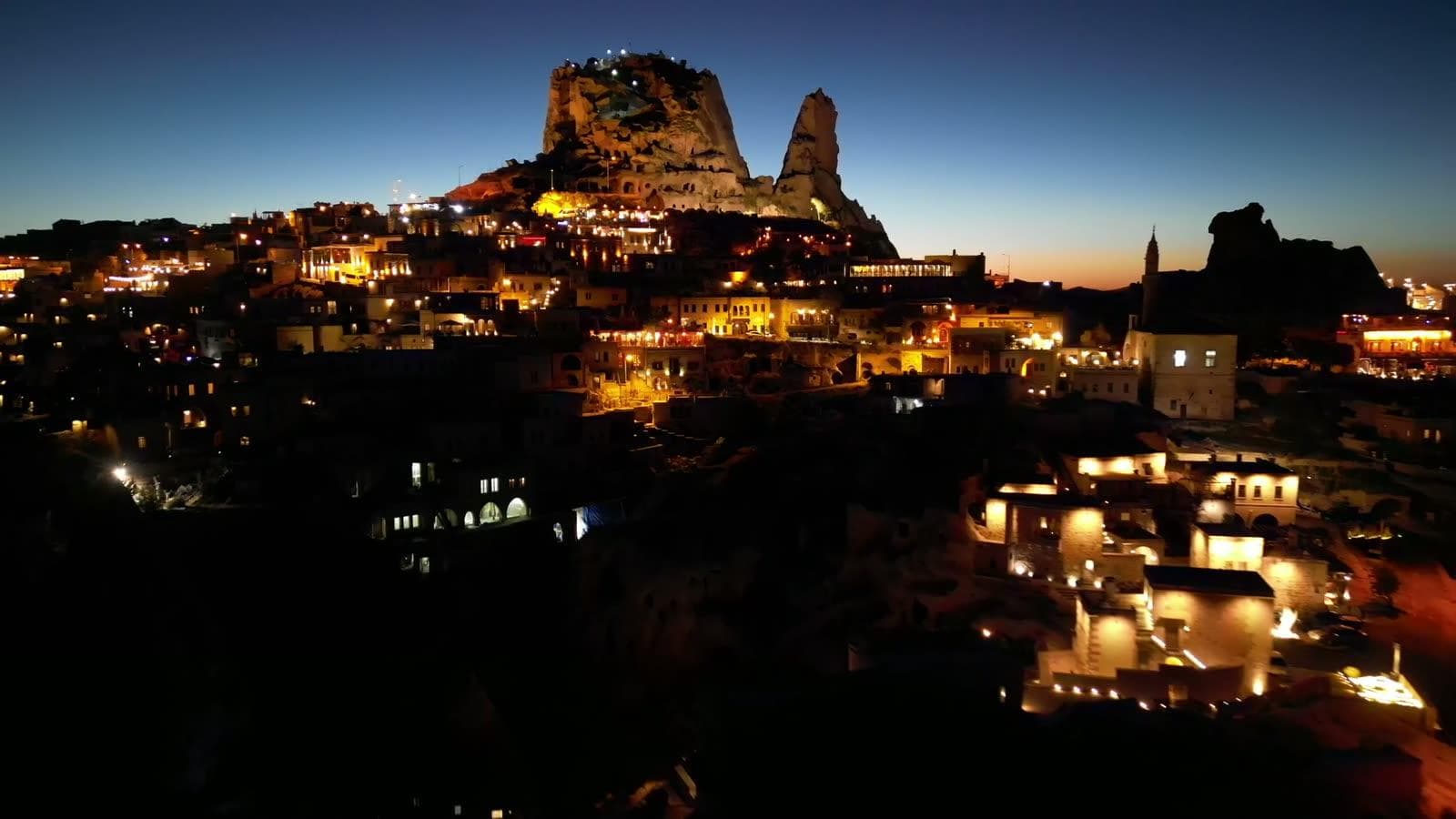
If you would rather stay away from Göreme's busiest streets but within 15 minutes of the museum, Uçhisar is a practical base. Breakfast is included at our hotel, open-air parking is free and the large terrace looks out over Uçhisar Castle. Read more about the village on our Uçhisar hotel page, or compare areas in where to stay in Cappadocia.
Sources
- T.C. Kültür ve Turizm Bakanlığı (muze.gov.tr) – Göreme Örenyeri
- T.C. Kültür ve Turizm Bakanlığı (muze.gov.tr) – Karanlık Kilise
- T.C. Kültür ve Turizm Bakanlığı (muze.gov.tr) – MuseumPass Cappadocia
- UNESCO World Heritage Centre – Göreme National Park and the Rock Sites of Cappadocia
- Turkish Archaeological News – Göreme Open Air Museum